Why Wait Until Your Child Is Born to Start Investing for Them?
If you enjoy this article, please checkout Boring Money Guy
My wife and I got married in April.
Hurray!
And there’s nothing quite like getting married to make everyone suddenly very interested in your reproductive plans.
Let me be clear, we don’t have a baby on the way.
But we do have an investment portfolio for one.
As things stand, there’s £486 sitting in my Trading 212 account, invested in exactly the same three boring ETFs as my own investments, in a separate pot.
The only unusual thing about this portfolio is that its intended owner doesn’t exist yet.
And, depending on how things go, might not exist for another couple of years or so.
So why on earth have I started investing for them already?
And, more importantly, why might you want to do the same?
Before anyone asks, no, I haven’t named the investment account after our imaginary child.
I’m not that far gone.
So then—
Why on earth am I doing this?
Personally, I blame Damien Talks Money.
I was watching one of his videos about the future of the UK’s pension system, and he mentioned an idea that stuck with me.
What if the government invested £5,000 for every child when they were born?
Invest it at birth, leave it alone for 60 years, and let compound growth do its thing.
At an illustrative 7% annual return, that £5,000 could become roughly £290,000 by age 60.
Of course, £290,000 in 60 years won’t buy anywhere near what £290,000 buys today, and 7% is an assumption rather than a promise.
But still.
It’s an interesting idea.
Unfortunately, I don’t have £5,000 sitting around to invest for a baby we haven’t had.
What I do have is about £50 a month and a slightly unhealthy enthusiasm for financial spreadsheets.
So I started playing with the numbers, and eventually I came to a rather obvious conclusion.
If starting at birth is such a good idea, why even wait until birth?
The advantage of not existing yet
There’s an obvious financial benefit to having parents who start investing before you’re born.
You get to enjoy the benefits without having to, you know, do anything.
And although two years might not sound like much, I was curious how much difference they could actually make.
So, naturally, I opened a spreadsheet.
Here’s what I found.
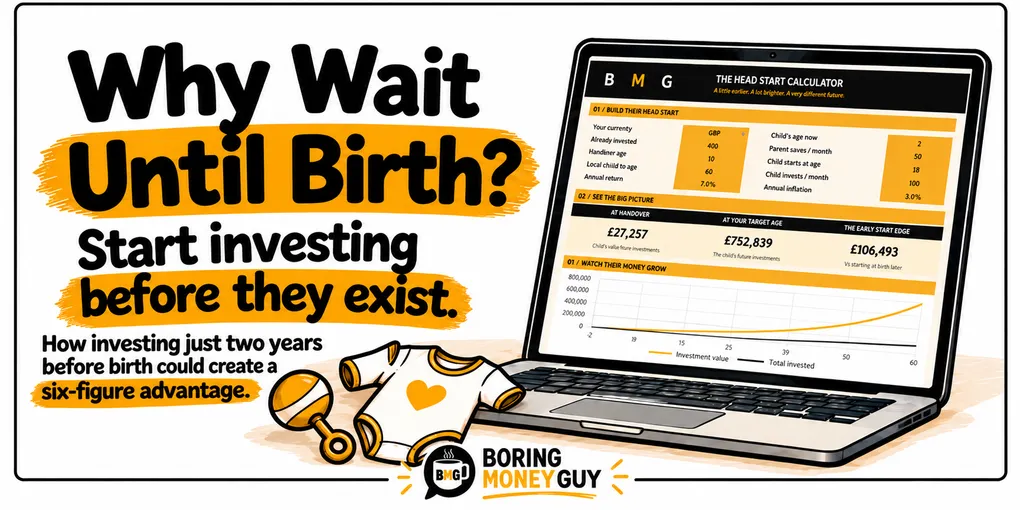
- Start investing at birth: £21,046
- Start investing two years before birth: £27,257
That’s an extra £6,212 by their 18th birthday.
And remember, I’m still investing exactly the same £50 a month after they’re born. The difference comes from the money already invested, those extra two years of contributions, and the additional growth.
I don’t think that’s a bad return on getting a little ahead of ourselves.
But here’s where things get really interesting.
Because I don’t intend for our child’s investing journey to end at 18.
Ideally, that’s when they’ll start taking over…
The bit they have to do themselves
There’s only so much of their financial future I can build for them.
I could spend the next 20 years diligently investing, building up a lovely little pot of money, only for them to blow the lot on something ridiculous.
Which, admittedly, would be their decision to make with any money that legally belongs to them.
But let’s assume I’ve Raised Them Ready and they picked up where I left off.
At 18, they take over the investments, which could be worth around £27,000 by then.
They start putting in £200 a month themselves, and keep it up until they’re 30.
Same 7% assumed annual return.
Here’s what my spreadsheet reckons:

£105,682 by their 30th birthday.
That’s a pretty substantial house deposit. And they’d still have another 30-odd years until retirement.
But look at that third number.
£13,990.
That’s how much extra they could have at 30, purely because I started investing before they were born, rather than waiting until birth.
They’d have invested exactly the same amount themselves either way.
Almost £14,000 extra, simply because their dad was a little too enthusiastic about spreadsheets before they existed.
Now let’s assume they don’t sell their investments at 30 and instead keep adding £200 until they’re 60:

Over a million pounds.
Which is lovely, although inflation will have had a rather large nibble at that figure by then.
But again, look at that third number.
£106,493.
That’s how much more they could have at 60 because I started investing a couple of years before they were born.
Over £100,000 extra.
Just from starting something I was planning to do anyway, a couple of years earlier.
The potential difference is enormous.
Now, I appreciate not everyone has the luxury of knowing they might want children a few years in advance.
And plenty of people are already struggling with the cost of raising the children they have.
I get it.
But if you’re planning to have children someday, and you’ve got a little money you can comfortably put aside, why wait until they’re here?
You don’t need £5,000.
You don’t even need £50 a month.
You just need an amount you can afford, and somewhere sensible to put it.
As for me, I’ll keep adding to my £486 pot.
Hopefully, in a couple of years, there’ll be an actual child to go with it.
Although given how much I’ve already thought about their finances, I dread to think what I’ll be like when they arrive.
If you enjoy this article, please checkout Boring Money Guy