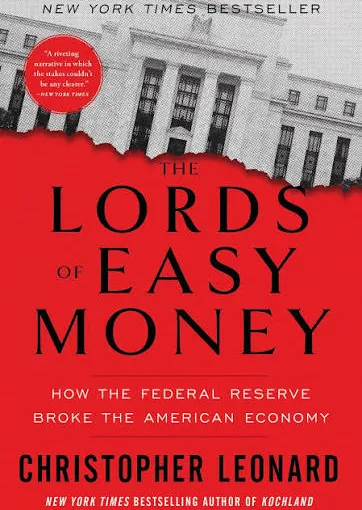
The Lords of Easy Money
A book about the Federal Reserve. Not exactly the first thing you’d pack for a holiday is it?
For my fellow Brits, the Federal Reserve (the Fed) is America’s central bank, basically their version of the Bank of England. It sets interest rates for the biggest economy in the world, so whether you like it or not, what it does has a knock-on effect on everything from your mortgage to your pension, and that global index fund I keep banging on about.
The Lords of Easy Money by Christopher Leonard is the story of how the Fed kept money cheap and plentiful for more than a decade after the 2008 crash, and the one man on the inside who kept trying to stop it.
His name is Thomas Hoenig.
Who is Thomas Hoenig?
Hoenig comes across as principled and well meaning from the very first chapter. You are taken through his early life in Fort Madison, Iowa, and his experience of the Vietnam War.
When his draft notice landed, he decided to enlist. Even here you can see the early signs of a man who was always thinking about the long term.
The book goes to considerable lengths to paint a picture of an honest, nice and proper man. Nowhere more so than during the 1980s banking crisis, when he was working in bank supervision at the Kansas City Fed (the Fed is split into 12 regional banks, Kansas City is one of them). He was in charge of assessing the banks for bailouts, and telling many of them that they were going to be allowed to fail. Around 350 banks in the Kansas City Fed’s patch either closed or needed rescuing.
Not a job I’d fancy.
He seemed to do it in a fair, respectful, but sensible way, which protected the Kansas City Fed. It was his performance here that got him the top job, and in 1991 he became president of the Kansas City Fed. He stayed for 20 years.
Never vote against the chairman
This is where the book really earns its money. It’s a great behind the scenes look at how the Federal Open Market Committee (FOMC) works and makes decisions.
The FOMC is the group that sets US interest rates. Twelve people get a vote: the seven Fed governors in Washington, the head of the New York Fed, and four of the other eleven regional presidents, who take it in turns.
On paper that sounds like a healthy debate. In reality, close votes are almost unheard of, because the FOMC often shows deference to the Fed chairman. As Hoenig puts it in the book, “There’s not a manual that says you don’t vote against the chairman.” You get the feeling everyone in the room acts like there is one.
Even Hoenig went along with it. In 1998 he was sceptical of cutting interest rates into a stock market that was already a bubble, and questioned whether they were just pouring gasoline on the fire (petrol, for us Brits). He ended up voting for the cut anyway.
That deference is part of the reason why chairmen like Alan Greenspan and Ben Bernanke were so influential on history. If the committee nods along, the chairman’s view is the Fed’s view.
It didn’t mean Hoenig kept quiet outside the room though. He wasn’t afraid to say what he thought. In the lead up to the 2008 crash he stood in front of a convention of banking executives and gave a scathing speech about their previous irresponsible behaviour. Age-old behaviours like greed, short-sightedness and arrogance were at the centre of banking problems, he told them, and “they are with us today just as they were in the 1980s.”
Unsurprisingly, the end of the speech was met with silence.
Eight times no
Then came 2010.
After the 2008 crash the Fed had cut interest rates to almost zero, and it was buying up bonds with newly created money. This is quantitative easing (QE). (Yes I know it’s not literally printing money, no hate mail please.)
Hoenig voted against the committee at all eight of its meetings that year. Every single one. He didn’t like the promise to keep rates at rock bottom for an “extended period”, and he didn’t like the second big round of QE.
His argument was that easy money doesn’t spread evenly. It flows to the people who already own things: shares, property, private equity, hedge funds. If you own assets, you get richer without lifting a finger. If you don’t, you watch house prices run away from you while your savings earn next to nothing.
That’s the bit of the book that stuck with me the most. QE wasn’t neutral. It picked winners and losers, and the winners were mostly the people who were already winning. The Fed’s balance sheet went from around $800 billion before 2008 to nearly $9 trillion in 2022, which is a lot of easy money looking for a home.
If you read my Financial Nihilism piece, this is a big part of where that “the game’s rigged” feeling comes from.
Hoenig paid the price for sticking his neck out. He was written off as a stubborn hawk (someone who prefers higher interest rates to keep inflation in check) and largely ignored. He retired from the Kansas City Fed in 2011, but he didn’t go quietly. He thought the reforms after 2008 hadn’t gone far enough, and as vice chairman of the Federal Deposit Insurance Corporation (FDIC), the US agency that protects people’s bank deposits, he wanted to break up the big banks. Everyday commercial banking on one side, the riskier investments in separate institutions on the other.
I can’t help thinking the world would be a better place if people had listened to him.
Jay Powell and Kevin Warsh
Hoenig wasn’t the only one with doubts. He was just the only one who kept voting that way.
Jay Powell became another key critic of QE. After joining the Fed’s board in 2012 he warned, behind closed doors, that bonds were trading well above what they were really worth. And perhaps encouragingly, so was Kevin Warsh, a Fed governor through the 2008 crash who opposed the $600 billion second round of QE in 2010.
The difference is what they did next.
Powell voted for it anyway. Then as chairman in 2020 he oversaw the biggest dose of easy money of the lot. Powell went with the flow.
Warsh also voted yes (that deference again), but then wrote a piece in the Wall Street Journal questioning the whole thing, and left the Fed a few months later.
Why does this matter now? Because since May, Warsh has been the one running the Fed. The book helps show him as a serious operator, rather than the Trump stooge some of the headlines would have you believe. He has already said the Fed’s balance sheet has grown “far too big”. I suspect Hoenig would approve.
Bailing out the hedge funds
In September 2019 the repo market seized up. Repo (short for repurchase agreement) is where banks and big investors borrow cash overnight, handing over government bonds as security. It’s the plumbing of the financial system, and suddenly the pipes were blocked.
The Fed stepped in with emergency lending and created hundreds of billions of dollars to get things flowing again. According to the book, a big part of the strain came from hedge funds running bets with huge amounts of borrowed money. So in practice, the Fed bailed out the hedge funds.
Why not let them find out the risks of their actions? If you or I made a bet with borrowed money and it went wrong, nobody would be creating money to get us out of it. Just ask the young South Korean investors I wrote about a few months ago.
Is this the socialism Americans keep telling us they are against?
Is the book too kind to Hoenig?
Probably, yes.
Leonard clearly likes him, and Hoenig is the hero of the story from start to finish. You see most of the big arguments through his eyes. And he’s human too, he did nod through that 1998 rate cut after all.
The other thing to remember is that Hoenig was warning about inflation back in 2010, and for the next decade inflation stayed stubbornly low. When it finally did arrive in 2021 and 2022, there was a lot else going on: a pandemic, broken supply chains and a war in Ukraine.
But I don’t think that undermines his main point. His bigger worry was what years of free money would do to asset prices and risk-taking. Look at house prices, the gap between the haves and the have-nots, and the hedge funds being rescued in 2019, and he looks pretty spot on.
So yes, a bit too kind. But kind to someone who mostly deserves it.
The verdict
It reads somewhat like a story and isn’t as dry as you would expect a book about monetary policy to be! I’d recommend it to anyone who has a base interest in monetary policy and finance as a whole.
And if you don’t have that interest, I’d gently suggest that you should.
I know this stuff can be boring. Committee votes, bond buying, the repo market… it’s hardly Saturday night telly. But decisions made in that room in Washington ripple out into your mortgage and your pension, wherever you live. It’s much easier for people to get away with things when nobody is paying attention.
Adam’s verdict: 8/10
Read it, and the next time someone tells you the Fed is boring, tell them about the man from the Kansas City Fed who said no eight times in a row.