Why Every Billionaire Suddenly Owns a Piece of a Sports Team
If you enjoy this article, please checkout Flora Hewitt
Jeff Bezos just agreed to buy a piece of Liverpool. Fenway Sports Group agreed this week to sell roughly 30% of the club to a consortium called 1892 Holdings, which includes Bezos alongside Facebook co-founder Eduardo Saverin and lead investor Amit Bhatia, in a deal worth about £1.65 billion that values Liverpool near £5.5 billion, or roughly $7 billion. It is Bezos’s first sports investment. Everyone is reading this as a story about the world’s richest people falling in love with sports. It is actually a story about two separate financing mechanisms, one that just opened and one that has been deliberately kept shut, both converging on the same asset class at the same time.
The scarcity was never about fandom
Start with the number that explains everything else: the average NFL franchise was worth $1.2 billion in 2013 and $5.7 billion in 2024. League revenue did not go up nearly 5x in that window. What changed is the ratio of billionaires to sport franchises.
The supply side has barely moved. There have been 32 NFL teams since 2002 and 30 NBA teams since 2004. The demand side has not stood still at all: Forbes counted 1,426 billionaires worldwide in 2013, with combined wealth of $5.4 trillion; by 2026 that had grown to 3,428 billionaires worth a combined $20.1 trillion, more than double the headcount and nearly quadruple the wealth, far outpacing global GDP growth over the same period. A fixed number of trophy assets, bid on by a pool of buyers that keeps multiplying and getting richer, is a textbook setup for prices to run away from any fundamental tied to the underlying business. That is the actual driver of the 5x jump in franchise values: more, and wealthier, bidders chasing the same 32 seats at the table.
Here is where it gets interesting, though. That same price escalation eventually outruns even a fast-growing billionaire population. There are fewer than 200 Americans worth $5.7 billion or more, and roughly a dozen of them already own an NFL team. For context, only two NBA teams and one MLB team are valued above that $5.7 billion threshold at all, meaning even a healthy chunk of the billionaire class cannot cover the sticker price for a top franchise from personal wealth alone, without selling down a stake in whatever business made them rich in the first place.
So the constraint was never a shortage of billionaires. There are more of them than ever. That is exactly what pushed prices this high in the first place. The real constraint was different: a shortage of buyers who could write that check alone. The wider pool had already bid the price up past what almost anyone could cover from personal wealth. That distinction matters. It is what actually explains why leagues changed their financing rules. The goal was not to manufacture more interest in owning a team. It was to let a still-enormous pool of would-be buyers actually close the check.
The financing rules just loosened
Every other major US league had already solved this problem by letting private equity in over the course of the 2010s and early 2020s. The NFL held out, the last of the major leagues to prohibit it, until August 2024, when owners voted 31 to 1 to let private equity funds buy up to 10% of a franchise.
The NBA went further in December 2025, expanding how many teams a single private equity fund can hold stakes in from five to eight, on top of an existing rule letting a fund own up to 20% of any one team and a 30% aggregate institutional-ownership cap per franchise.
Neither league opened the door because it suddenly trusts institutional money. Both did it because their own owners had become too rich on paper and too illiquid in practice to keep buying each other out, or to keep funding stadiums, without an outside source of capital.
Read the fine print and the real function of these deals becomes clear. Per Axios’s reporting on the NFL’s rule change, private equity’s initial entry produced partial liquidity events for existing owners: cash pulled out without giving up control, used for stadium renovations, other investments, or diversification. The Buffalo Bills and Miami Dolphins confirmed PE investment within months of the rule change, and the San Francisco 49ers began weighing a sale of up to 10% shortly after.
That is the detail the “billionaires love sports” framing misses. The person selling the stake already owns the team. They are cashing out a slice of an appreciating, artificially scarce asset to institutional money that has nowhere else to deploy this much capital at this kind of scarcity premium, while keeping the keys.
Formula 1 keeps its supply deliberately locked
Where the NFL and NBA loosened who can pay, Formula 1 did the opposite: it kept supply locked on purpose, with the scarcity itself priced as a fee.
There were ten F1 teams for years. An eleventh, Cadillac, joined the grid in 2026, and to do it, General Motors had to pay a $450 million anti-dilution fee, split equally among the ten existing teams at $45 million each, purely to compensate them for the future dilution of their share of prize money. That fee is not a cost of doing business. It is the price of admission to a fixed club, and F1 CEO Stefano Domenicali has said the sport is already “at a point with no more room” and is not planning a twelfth team anytime soon.
The valuations that followed are the payoff. The average F1 team is now worth roughly $3.42 billion, more than double the $1.61 billion average that Sportico calculated for F1 teams back in 2023. Mercedes sold a 15% slice of Toto Wolff’s ownership stake to CrowdStrike founder George Kurtz at a $6 billion valuation in November 2025. Aston Martin, bought by Lawrence Stroll in 2018 for under $100 million as what looked at the time like a vanity purchase, is now valued at roughly $3 billion. Red Bull’s second team, Racing Bulls, reportedly turned down a takeover bid worth around $2 billion in November 2025.
None of that is explained by better racing. As Elis Wyn Jones, the former head of Goldman Sachs’ global sports advisory practice, put it at a recent industry conference, there are 32 NBA teams, 30 NFL teams, and 20 Premier League clubs, of which five or six are truly premium; there are 11 Formula 1 teams, with the potential for a 12th, and that is it. Scarcity that tight, against a global pool of billionaires that keeps growing every year, is the entire valuation story, no financing rule change required.
The dates are the tell
If the financing story is right, it should show up in the timeline of purchases, not just the price tags.
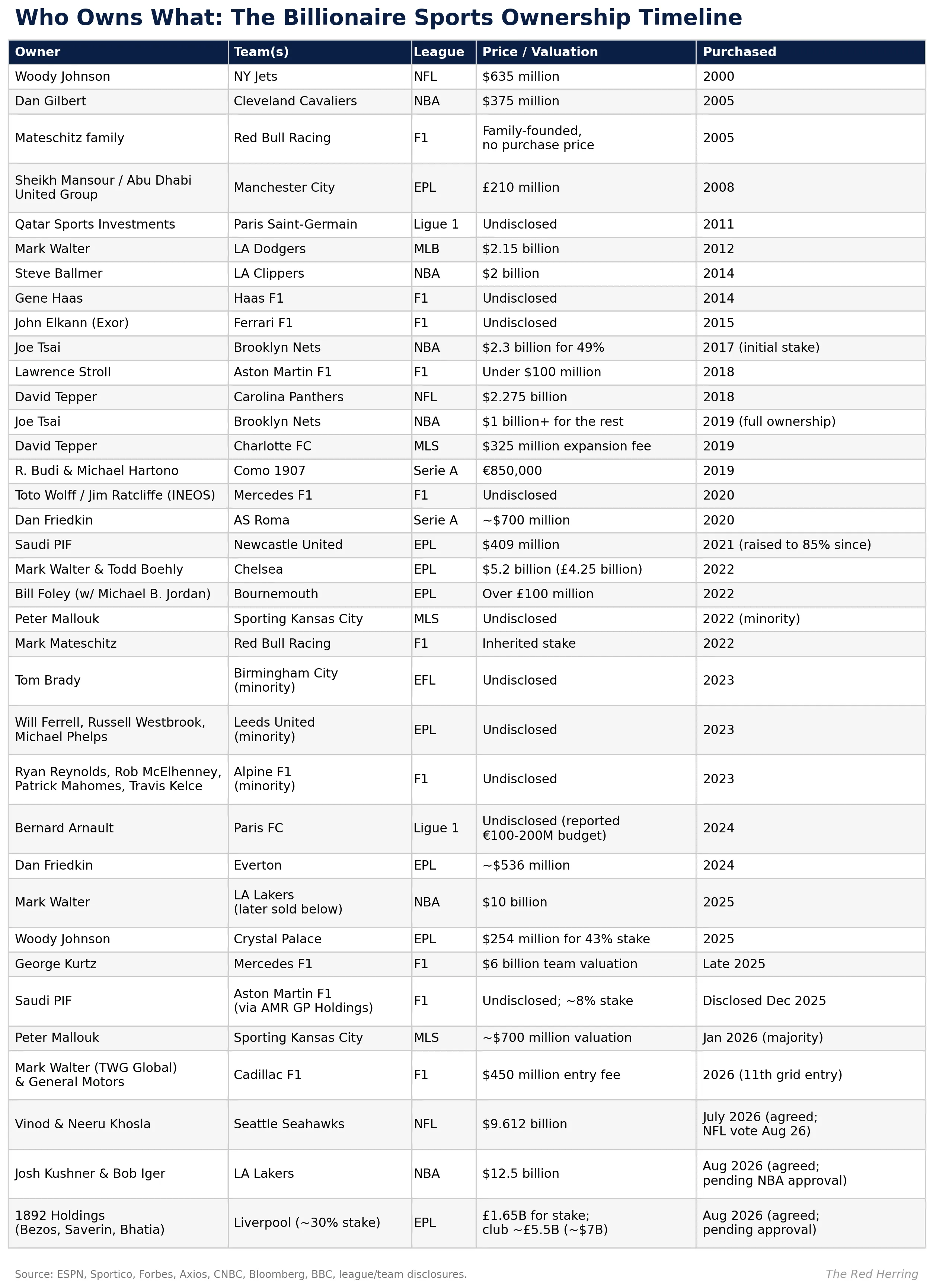
Look at where the deals bunch up. There is a scattering of purchases across the 2000s and 2010s: Ballmer, Gilbert, Tepper, the Gulf sovereign funds, buying in at what now look like discount prices. Then, starting around 2022 and accelerating hard through 2025 and 2026, the pace changes entirely. The Lakers alone changed hands twice in the past two years, first to Mark Walter at $10 billion in 2025, then agreed to Kushner and Iger at $12.5 billion in 2026, a 25% markup in roughly twelve months with no change to the product on the court. The Seahawks, Sporting Kansas City, Everton, and Mercedes’ minority stake all turned over within the same eighteen-month window.
That clustering is the visible effect of the NFL’s August 2024 vote and the NBA’s December 2025 expansion working their way through the market.
The buyer that does not fit either story
Sovereign wealth funds break that pattern entirely, and any honest accounting of who is buying sports teams has to include them.
Saudi Arabia’s Public Investment Fund led a consortium that bought Newcastle United for around $409 million in October 2021, and has since raised its stake to 85%. Abu Dhabi’s Sheikh Mansour bought Manchester City in 2008, and Qatar Sports Investments, a Qatar Investment Authority subsidiary, bought Paris Saint-Germain in 2011. PIF has also taken a previously undisclosed minority stake of roughly 8% in the Aston Martin Formula 1 team itself, held through a vehicle called AMR GP Holdings, separate from the fund’s larger 20.5% stake in Aston Martin’s publicly listed road-car business, putting sovereign capital directly inside the scarcest asset class described above.
A sovereign fund managing hundreds of billions in reserves is not short on capital, and it is not chasing a return the way a pension fund or a PE shop is. Analysts describe the motive as soft power and economic diversification as much as financial return, tied to national strategies around hosting the 2034 World Cup and building out a domestic sports economy. It is worth naming plainly: some of the capital flowing into this asset class is not optimizing for yield at all, and pretending every buyer is playing the same financing game as Josh Kushner or a PE-backed NFL minority stake would flatten a genuinely different kind of transaction into a story that does not fit it.
The trophy is the real backstop
J.P. Morgan’s private bank surveyed 111 billionaire family-office principals in 2025 and found sports teams have overtaken art and cars as the preferred trophy asset: 34% of respondents held stakes in teams or arenas, against 23% for art and just 10% for cars. Twenty percent now hold a controlling stake in a team outright, up from 6% just three years earlier. That is not a rounding error in a portfolio; that is a wealth class actively reallocating its trophy budget toward franchises.
The reason is straightforward once you separate the return from the return on capital. Ownership functions as a passport into rooms money alone does not open: the owners’ box, league meetings, the calls that get returned. It is also a legacy play with a longer time horizon than almost any other asset a family office holds; Jerry Buss bought the Lakers, along with the Kings, the Forum, and a large California ranch, for $67.5 million in 1979, and his family held the team for 46 years before this year’s sale. No spreadsheet return justifies holding an asset for 46 years the way “put my family’s name on a city permanently” does.
That is precisely why the price does not need a clean financial justification to keep climbing. As long as the number of billionaires in the world keeps growing faster than the fixed number of franchises, prestige demand alone keeps bidding the price up, independent of whether the underlying business throws off any cash. PE funds and sovereign wealth funds are, in effect, pricing their stakes against a backstop of a growing pool of billionaires who will always overpay for the trophy, which is what makes the asset class safe to underwrite in the first place.
The actual takeaway
The interesting story was never whether billionaires like owning sports teams. The intangible value of a trophy asset, visibility, and a seat at the table of a closed league has never been in question. The interesting story is that two different mechanisms, one newly opened and one deliberately kept shut, are both pushing prices up at once, joined now by sovereign capital that is not playing either game. All three converge on the same conclusion: this looks less like a hobby and more like real estate in a city that has stopped issuing new building permits, chased by a buyer pool that keeps getting richer and, as of the last two years, keeps getting new ways to pay.
— Flora Hewitt