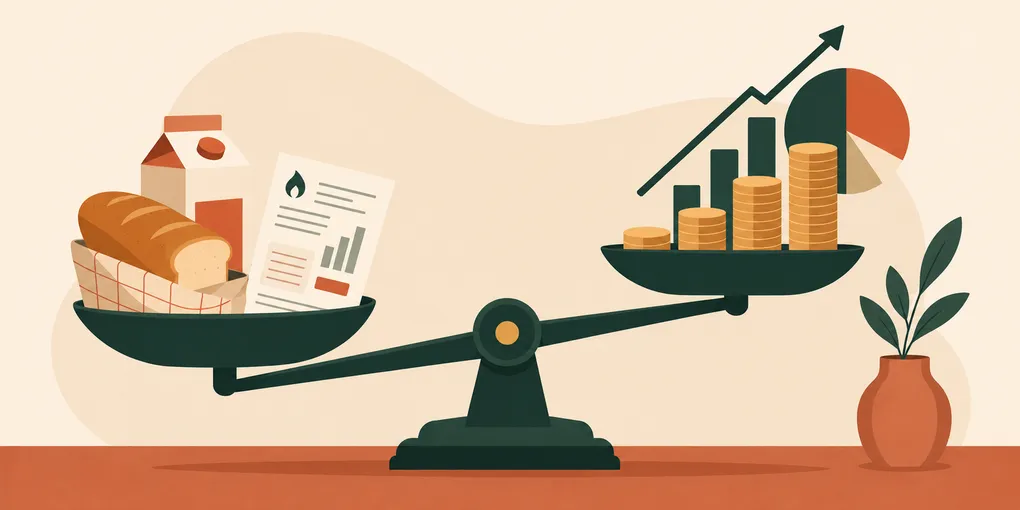
3 reasons inflation hits poorer households hardest
If you enjoy this article, please checkout Pounds & Pennies
Turn on the news today, and it’s hard to escape: Inflation.
(Or perhaps the “cost of living”, as it’s more commonly known.)
And there is good reason for this.
Over the last few years, we have seen several inflationary impulses which have impacted everyday prices. For example:
- Supply backlogs and money printing associated with COVID-19
- Shortages driven by the Ukraine / Russia war
- Increasing tariffs creating price inflation for consumers
- Recent spikes in energy prices driven by the conflict in the Hormuz Strait.
Most people will, I think, naturally understand why inflation is bad for us.
It costs us more to buy things, and unless wages keep up, we are all, therefore, poorer in “real” terms.
However, in this article, I wanted to explore specifically the reasons why inflation is particularly bad for lower-income households.
1) Poorer households tend to spend a greater share of their income
The first key reason is that poorer households tend to spend a greater proportion of their overall income. This is as opposed to saving or investing it.
Let’s take a simplified example:
- Sam needs £2,000 per month to live on.
- He earns £2,500 per month after tax.
- He, therefore, spends 80% of his income and saves the remaining 20% (£500).
- Now assume inflation increases the average cost of living by 5%. This means Sam now needs £2,100 per month to live on.
- That equates to spending 84% of his income per month. An extra 4%. And he only gets to save 16% / £400 as a result.
Now assume his friend Helen has the same cost of living, £2,000.
- However, she earns a much higher income of £10,000 per month, after tax.
- Previously, before inflation, Helen’s costs were 20% of her income.
- After 5% inflation, her costs rise to £2,100.
- This is 21% of her income or 1% extra in addition.
Inflation “costs” the poorer person a 4% share of their income versus only 1% for the wealthier friend.
Presented in this way, inflation effectively operates as a tax. Because it occurs indirectly, it is often referred to as a “stealth tax”.
But worse, as demonstrated above, it is a regressive tax. A regressive tax is one that hits lower-income families harder on a proportionate basis.
Inflation is a tax nobody voted for, and the less well off in society sadly end up paying the highest rate.
2) Wealthier households invest a greater proportion of their income
The other key factor is that wealthier households usually invest more of their income.
Investments in assets tend to be more inflation-proof as they generally rise or even outpace the rate of inflation.
Note, this is a generalisation as there are many asset classes that underperform as inflation picks up. However, for simplicity, let’s assume that invested money generally performs better than cash during inflationary cycles.
Let’s revisit our previous example.
- After the effects of inflation, Sam has £400 he can choose to save and invest.
- If he had limited savings, he would probably want to save it all and hold it in cash, for which he would only earn a limited return.
- However, let’s assume he has an emergency fund already built up and can invest the £400.
- Helen, on the other hand, can invest £7,900.
- Even if they both receive the same rate of return (let’s say 10%), after 1 year, Sam’s wealth on that month’s income will have grown by £40 and Helen’s to £790.
- Seems pretty fair given the amount they both invested.
- However, relative to what they earn each month, Sam’s wealth has increased by 1.6% (£40 ÷ £2,500) and Helen’s by 7.9% (£790 ÷ £10,000).
Same rate of return. Wildly different outcome.
You can see, even accounting for the fact Helen earns a lot more than Sam, she is able to grow her wealth at a much faster rate than Sam is.
If Sam didn’t have an emergency fund already, this situation would be even worse. He would likely hold most of his savings in cash and therefore suffer an even lower rate of return.
If the above example was too long-winded, the TLDR is:
- Wealthier households can invest a greater share of their income.
- Investments tend to offer better protection from inflation.
- Therefore, wealthier households are more shielded from the effects of inflation than poorer households.
3) Wealthier people have more options available to adjust their consumption
The final point I wanted to make is around consumption patterns.
In the example above, I assumed both Sam and Helen had the same monthly expenses. In reality, Helen would probably spend a greater proportion of her income on obtaining a higher quality of life and enjoying more luxuries.
Sam, however, would probably spend the majority of his income on essentials, i.e. rent, food, utilities, etc.
That in itself gives Helen more options when hit by inflation, as she has a greater ability to reduce her consumption on a proportionate basis.
Some key ways she can do this are:
- She can choose to forego luxuries. For example, she may decide not to go on holiday if the costs are now too high.
- She can choose to substitute luxuries. Helen may still want to go on holiday but will have greater opportunity to downgrade to a cheaper holiday, e.g. a closer destination or more modest accommodation. Essentials are harder to substitute, which is why Sam has fewer options here.
- She can choose to delay consumption. Whilst both parties will need to continue to spend on essentials, Helen could choose to delay her holiday for the future when prices may reduce again.
The bottom line
Hopefully, this has given you a little insight into some of the reasons inflation is worse for poorer households than wealthier ones.
This is by no means an attack on wealth – far from it. But I think it’s important to understand the range of societal impacts that rising cost of living can have.
To summarise the key points:
- Poorer households “consume” a greater share of their income, which is therefore proportionately hit more by inflation.
- Wealthier households invest a higher share of their income, which provides shielding from the effects of inflation.
- Wealthier households have more flexibility to modify their consumption habits as they spend a smaller percentage of their income on “essentials”.
- As a result, high inflation exacerbates the gap between the wealthier and the poor.
As always, nothing in this article should be considered financial advice. I write for fun and am not a financial advisor. The analysis here is intended to be informative and thought-provoking, not a recommendation to buy, sell, or do anything with your money.
If you enjoy this article, please checkout Pounds & Pennies