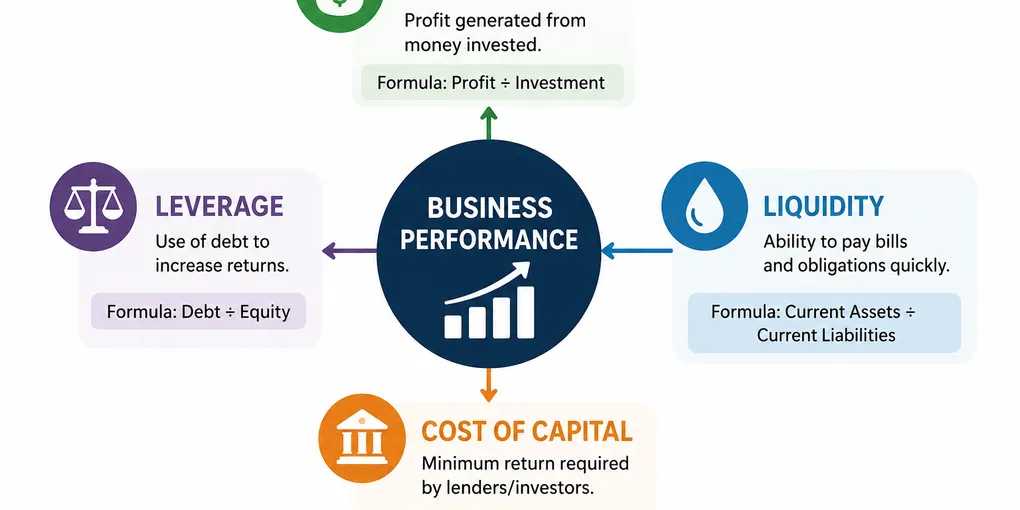
4 Finance Terms You’ll Hear All the Time
If you enjoy this article, please checkout Plain English Investing
This article is pretty much for beginners, or could also be treated as a refresher. It is incredibly basic. I cover four different finance terms that are casually used in the business and investing world. No jargon.
If you’ve ever read a stock article or listened to an earnings call and felt like everyone was speaking a different language, welcome to the party! Investing has its own vocabulary, and a lot of it sounds more complicated than it actually is.
Today I want to break down four terms that show up constantly in the investing world. No jargon, no fluff — just plain explanations with real numbers so they actually stick.
1. Return on Investment (ROI)
ROI tells you how much money you made (or lost) on something, compared to what you put in. It’s basically a report card for your investment.
Example: Say you put $1,000 into a stock, and later it’s worth $1,200. You made $200. Divide that $200 by your original $1,000, and you get 20%. That’s your ROI — a 20% profit. See? You got it.
The higher the ROI, the better the investment performed relative to its cost. It’s one of the simplest ways to compare how different investments are doing.
2. Leverage
Leverage just means using borrowed money to make an investment bigger than what your own cash could buy alone.
Think of it like using a small down payment to buy a house instead of paying the full price in cash. You’re using debt to control something much larger, with the hope that it grows in value by more than what you owe.
Why people use it: Leverage can boost your returns because you’re investing with more money than you actually have. But here’s the catch — it works both ways. If the investment loses value, your losses get bigger too. Leverage is a tool that adds both opportunity and risk to the table. Beginners should not trade with leverage!
3. Cost of Capital
This one sounds intimidating, but it’s really just asking: “What does it cost a company to get the money it uses to run and grow?”
Companies raise money in two main ways — borrowing it (debt) or selling ownership stakes (equity, i.e. stock). Both of these come with a cost. Lenders want interest payments back. Shareholders want a solid return on their investment, or they’ll put their money elsewhere.
The cost of capital is basically the minimum return a company needs to generate on its projects just to keep its investors and lenders happy. If a company can’t clear that bar, it’s not creating real value — it’s just spinning its wheels.
4. Liquidity
Liquidity is how quickly and easily you can turn something into cash without losing value in the process.
Example: Cash itself is the most liquid asset there is — it’s already cash. A stock in a big, popular company is also pretty liquid, since you can usually sell it in seconds. On the other hand, something like real estate or a rare collectible is far less liquid, since it can take weeks or months to find a buyer at a fair price.
Why does this matter for investors? Because life happens. If you suddenly need cash, you want to know how fast you can actually access your money without taking a loss just to speed up the sale.
The takeaway: These four ideas — ROI, leverage, cost of capital, and liquidity — show up everywhere in investing, from news headlines to company earnings reports. You don’t need a finance degree to understand them. Once you know what they mean, a lot of the “complicated” investing talk starts to make a lot more sense.
If you enjoy this article, please checkout Plain English Investing